








Cryogenic Tank vs Standard Industrial Tank: What's the Difference?
Introduction
If you're sourcing industrial storage equipment, you've likely come across two terms: cryogenic tanks and standard industrial tanks. At first glance, they may look similar — both are cylindrical pressure vessels, both store liquids, and both sit on concrete foundations. But that's where the similarities end.
Choosing the wrong tank type can lead to equipment failure, safety hazards, product loss, or costly redesigns. In this article, we'll break down exactly what sets cryogenic tanks apart from standard tanks across every dimension that matters.
What Is a Standard Industrial Tank?
A standard industrial storage tank — also called a conventional pressure vessel — is designed to store liquids or gases at or near ambient temperatures. These tanks are common in the chemical, food, water treatment, and petroleum industries.
Typical operating temperatures range from -30°C to +200°C, and they handle substances like water, diesel, chemicals, edible oils, and compressed air.
What Is a Cryogenic Tank?
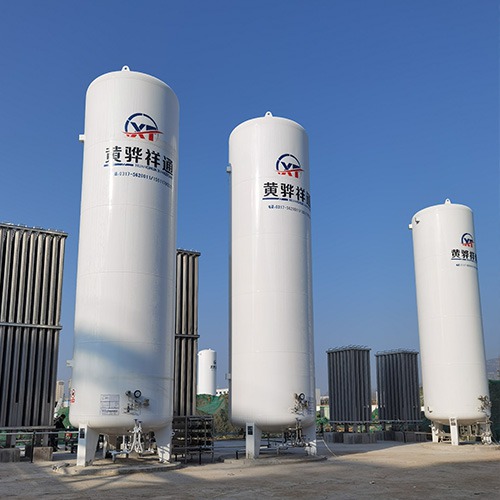
A cryogenic storage tank is designed to store liquefied gases at extremely low temperatures, well below their boiling points — typically below -150°C (-238°F). These tanks are essential for industries that rely on gases like LNG, liquid nitrogen (LIN), liquid oxygen (LOX), and liquid argon (LAR).
The extreme temperatures involved require fundamentally different engineering compared to standard tanks.
Key Differences: Side-by-Side Comparison
| Feature | Standard Industrial Tank | Cryogenic Tank |
|---|---|---|
| Operating Temperature | -30°C to +200°C | -196°C to -270°C |
| Stored Media | Water, diesel, chemicals, oils | LNG, LIN, LOX, LAR, LCO₂, LH₂ |
| Inner Material | Carbon steel, painted steel | Stainless steel 304L/316L, specialized alloys |
| Insulation | None or minimal | High vacuum + perlite powder / MLI |
| Construction | Single-wall | Double-wall (vacuum-annular) |
| Design Pressure | 0.2 – 2 MPa typical | 0.2 – 3.5 MPa (up to 36 bar for specialized) |
| Design Standards | ASME VIII, GB/T 150 | ASME VIII + Cryogenic appendices, PED |
| Boil-Off Rate | Not applicable | 0.1% – 0.5% per day |
| Safety Hazards | Corrosion, overpressure | Cryogenic burns, oxygen displacement, rapid pressure rise |
| Inspection Frequency | Every 5 years (typical) | Annual PRV test + 5-year internal |
1. Temperature Range: The Fundamental Difference
This is the single most important distinction. Standard tanks operate at temperatures where carbon steel remains ductile and manageable. Cryogenic tanks must handle temperatures where carbon steel becomes brittle (transition temperature) — which is why stainless steel and specialized alloys are mandatory.
For example:
Storing liquid nitrogen at -196°C requires a tank designed specifically for cryogenic service
Storing diesel at +25°C needs no special cryogenic engineering
2. Materials: Why Stainless Steel Is Non-Negotiable
At cryogenic temperatures, ordinary carbon steel loses toughness and can fracture catastrophically without warning — a phenomenon known as ductile-to-brittle transition.
Cryogenic tanks are therefore made from:
Stainless Steel 304L: Standard for LOX, LIN, LAR storage
Stainless Steel 316L: Required for corrosive media like certain LNG compositions
9% Nickel Steel: Used in large LNG tanks for enhanced toughness at -196°C
Aluminum alloys: Common in smaller dewars and transport tanks
3. Insulation: Single Wall vs. Double Wall
Standard tanks typically have no insulation or minimal insulation for weather protection only.
Cryogenic tanks use a double-wall design with a vacuum-annular space between the inner and outer vessels. This vacuum dramatically reduces heat transfer by conduction and convection.
Common insulation configurations:
High Vacuum (≤10⁻³ mbar): The primary method; achieves extremely low heat ingress
Perlite Powder: Fine mineral powder filling the annular space for additional insulation
Multi-Layer Insulation (MLI): Super-insulated blankets used in high-performance tanks (space-grade)
Lower heat ingress = lower boil-off rate = more product saved.
4. Pressure Control: More Complex Systems
Both tank types need pressure management, but cryogenic tanks face a unique challenge: continuous boil-off gas generation.
Standard tanks: pressure fluctuations are usually slow and manageable with simple vents.
Cryogenic tanks require:
Pressure Relief Valves (PRV): Precisely calibrated for cryogenic service
Full rupture discs: Burst at a set pressure to prevent tank overpressure
Pressure building vaporizers: Convert liquid to gas to create withdrawal pressure
Continuous pressure monitoring: With digital gauges and alarms
5. Safety Hazards: Different Risk Profiles
Standard tank risks: Corrosion, overpressure (thermal expansion), foundation settlement, fire (for flammable contents).
Cryogenic tank risks:
Cryogenic burns: Direct contact causes severe tissue damage within seconds
Rapid pressure buildup: Boil-off gas can cause overpressure in minutes if not managed
Oxygen displacement: LN₂ evaporates to 674× its liquid volume — can displace breathable air in enclosed spaces
Brittle fracture: Wrong materials fail without warning
LNG fire/explosion: Flammable — requires ATEX-rated equipment in hazardous areas
6. Design Standards: Different Rule Books
Standard tanks are designed to codes like ASME Section VIII Division 1 or GB/T 150.
Cryogenic tanks must additionally comply with:
ASME Section VIII Division 1 + Special appendices for cryogenic service
PED 2014/68/EU (Europe) + Cryogenic Equipment Guidelines
ADR/RID (Transport): For tank trucks and ISO tank containers
ATEX 2014/34/EU: For explosive atmospheres (LNG storage)
7. Applications: When to Use Which
| Application | Tank Type |
|---|---|
| Storing drinking water | Standard tank |
| Storing industrial chemicals (ambient temp) | Standard tank |
| Bulk LNG storage at -162°C | Cryogenic tank |
| Hospital liquid oxygen supply at -183°C | Cryogenic tank |
| Steel industry liquid argon at -186°C | Cryogenic tank |
| Food freezing with liquid nitrogen | Cryogenic tank / dewar |
| Oil and diesel storage | Standard tank |
Frequently Asked Questions (FAQ)
No. Standard carbon steel tanks are not designed for cryogenic temperatures and will become brittle, creating a serious risk of catastrophic fracture. Only cryogenic-grade tanks with stainless steel or aluminum construction should be used.
With proper maintenance, cryogenic tanks typically last 20–30 years or more. Annual inspections of PRVs, periodic vacuum checks, and avoiding overfilling can significantly extend service life.
Yes, they require more specialized maintenance. PRVs must be tested annually by certified inspectors, insulation vacuum levels should be checked every 1–2 years, and inner vessel inspections are required every 5 years.
Choose a tank with higher-quality vacuum insulation, minimize fill/draw frequency (each fill introduces heat), ensure proper tank positioning (shaded, ventilated area), and maintain the outer shell to prevent damage.
Small dewars (up to ~1,000L) can be installed indoors with proper ventilation. Large stationary cryogenic tanks are designed for outdoor installation. Indoor LNG storage requires ATEX certification and strict safety protocols.