








Special requirements and usage instructions for low-temperature storage tanks
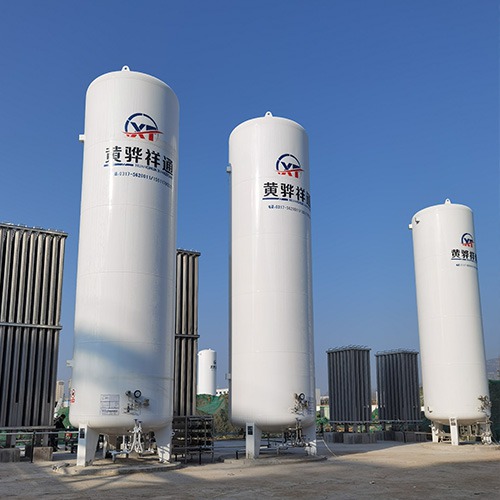
(1) What are the special requirements for LNG storage tanks? 1. The boiling point of liquefied natural growth gas under low temperature and atmospheric pressure is -160 ℃. The low-temperature storage tank adopts the low-temperature and atmospheric pressure storage method, which lowers the temperature of natural growth gas below the boiling point, making the operating pressure of the storage tank slightly higher than atmospheric pressure. Compared with the high-pressure and atmospheric temperature storage method, it can greatly reduce the thickness of the tank wall and improve the safety performance. Therefore, LNG requires storage tanks to have good low-temperature resistance and excellent cold insulation performance. 2. Enron's requirements are high. Due to the low-temperature liquid stored in the tank, in the event of an accident, the refrigerated liquid will evaporate in large quantities, with a gasification amount about 300 times that of the original refrigerated state, forming an automatically detonating gas mass in the atmosphere. Therefore, API, BS and other specifications require storage tanks to adopt a double-layer wall structure and use the sealing concept. When the first layer of the tank leaks, the second layer of the tank can completely seal off the leaked liquid and evaporated gas, confirming safe storage. 3. The material for the inner tank wall requires low temperature resistance, usually using 9Ni steel or aluminum alloy materials, while the outer tank wall is made of prestressed reinforced concrete. 4. The insulation measures are strict. Due to the high temperature difference between the inside and outside of the tank, which can reach 200 ℃, in order to maintain the temperature inside the tank at -160 ℃, the tank body must have good cold insulation performance, and stable cold insulation materials should be filled between the inner and outer tanks. The cold insulation material at the bottom of the tank also needs to have sufficient pressure bearing performance. 5. Seismic resistance (based on actual reports) is generally required for buildings to withstand seismic loads without collapsing. To confirm the safety of the storage tank under unexpected loads, the tank has good seismic resistance (based on actual reports). LNG storage tanks are required to not collapse or crack under specified seismic loads. Therefore, the selected construction site should generally avoid earthquake fault zones. Before construction, seismic tests should be conducted on the storage tanks to analyze their structural performance under dynamic conditions and confirm that the tanks will not be damaged under the given seismic intensity. 6. Strict construction requirements include 90% magnetic particle testing (MT) and 90% vacuum tightness testing (VBT) for tank welds. Strictly select insulation materials and follow the prescribed procedures during construction. To prevent concrete cracking, post tensioning and prestressing construction are adopted, and the verticality of the tank wall is strictly controlled. The concrete outer tank top should have high compressive and tensile strength, and be able to withstand the impact of general falling objects. Due to the thick concrete at the bottom of the tank, the hydration temperature should be controlled during pouring to prevent cracking caused by temperature stress. (2) The importance of liquefied natural growth gas storage tanks in the chemical industry is widely recognized, mainly due to the use of a highly vacuum refrigerator for storing liquid argon, which saves a significant amount of labor. For users who are using liquid argon storage tanks for the first time, it is not only difficult to use but also prone to accidents. However, for friends who are using liquid argon storage tanks for the first time, they can only avoid dangerous accidents by doing the following preparations. Let's take a look at the specific answers in the following text: First, check the liquid argon storage tank before use. When filling the liquid argon storage tank with liquid argon, check whether the shell is concave and whether the vacuum exhaust port is intact. If it is damaged, the vacuum degree will decrease, and in severe cases, the intake air cannot be insulated, causing frost to form on the upper part of the tank, resulting in significant loss of liquid argon and loss of value for continued use. 2、 Be careful when filling liquid argon. For new or dry cans, they should be slowly filled and pre cooled to prevent damage to the inner liner during rapid cooling and reduce their service life. When filling liquid argon, please do not pour liquid argon onto the vacuum exhaust port to avoid a decrease in vacuum degree. 3、 The storage capacity of liquid argon in the liquid argon storage tank. When storing liquid medium in the liquid argon tank, please make sure to close the inlet/outlet valve and pressure increasing valve, and open the vent valve. 4、 Transport of liquid argon in liquid argon storage tank When transporting liquid argon medium, it is necessary to protect the opening and closing status of each valve as during storage. Please seat the bottom cushion of the packaging box under the container seat circle and use ropes to securely fix the liquid argon tank container to the car, so that the liquid argon tank will not shake during transportation. 5、 Close the vent valve for the infusion of liquid argon in the liquid argon tank; Open the pressure boosting valve; Observe the pressure gauge; When the pressure rises to 0.05MPa (0.5kg/cm2), open the drain valve to allow continuous infusion. 6、 During use, regular checks should be conducted. You can observe with your eyes or touch the outer shell with your hands. If frost is found on the surface, the liquid argon storage tank should be stopped from use; Especially when frost and ice accumulate on the inner wall of the neck canal, it is not advisable to use a small knife to scrape it to prevent damage to the inner wall of the neck canal and poor vacuum. Instead, the liquid argon should be removed and allowed to melt naturally.