








Precautions and handling rules for maintenance of low-temperature storage tanks
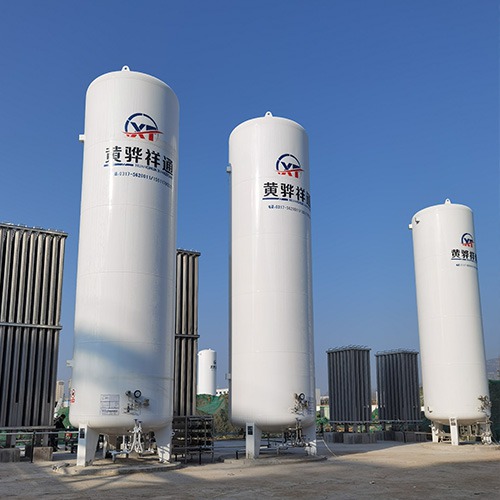
(1) LNG storage tanks are key equipment in gasification stations, and their insulation and sealing properties directly affect the evaporation and leakage rate of LNG storage tanks, that is, the rate of LNG loss and utilization. The performance parameters of storage tanks mainly include vacuum degree, leakage rate, and static evaporation rate. As a low-temperature container, LNG storage tanks meet the relevant technical requirements in national and industry standards. The vacuum sealing degree of a storage tank reflects its vacuum properties, but the vacuum degree decreases over time; The leakage rate of the storage tank affects the vacuum life of the storage tank, that is, the rate of change in the vacuum degree of the storage tank; The static evaporation rate can more intuitively reflect the cooling performance of the storage tank during use. LNG is the abbreviation for Liquefied Natural Gas in English, which stands for liquefied natural growth gas. It is the product of natural growth gas (methane CH4) being purified and cooled to liquefaction at ultra-low temperatures (-162 ℃, one atmosphere). The volume of liquefied natural growth gas is greatly reduced, about 1/600 of the volume of natural growth gas at 0 ℃ and 1 atmosphere, which means that 1 cubic meter of LNG can be gasified to obtain 600 cubic meters of natural growth gas. Colorless and odorless, mainly composed of methane with few other impurities, it is a very clean energy source. The liquid density is about 426kg/m3, and the gas density is about 1.5kg/m3. The explosion rate is 5% -15% (volume%), and the ignition point is about 450 ℃. The natural growth gas generated by oil/gas fields is formed through liquid removal, acid removal, drying, distillation, and low-temperature condensation, reducing its volume to 1/600 of its original size. The uniqueness of LNG storage tanks: Large capacity LNG storage tanks have their own characteristics compared to other petrochemical storage tanks due to their operation at ultra-low temperatures (-162 ℃). At the same time, during operation, due to the boiling state of the stored LNG, when external heat enters, or due to impacts during filling or changes in atmospheric pressure, the stored LNG will continue to vaporize into gas. Therefore, during operation, control of the pressure inside the storage tank, extraction and treatment of the vaporized gas, and refrigeration and cooling should be considered. In addition, accessories such as Anran valves, level gauges, thermometers, and expansion joints for inlet and outlet pipes of LNG storage tanks should also be resistant to low temperatures. The safety device of the storage tank can also start well under low temperature and low pressure. But how to make up for it? How can the effect of supplementary drawing be protected? We need to consider every detail, such as how to seal the vacuum port after replenishing it If any detail is not implemented properly, all previous efforts will be in vain. (2) What are the handling rules for the use of liquid nitrogen storage tanks? 1. Intention for the use of liquid nitrogen storage tanks: In order to strengthen the handling of liquefied natural growth gas storage tanks, achieve correct use, and confirm the safety of production, corresponding rules should be formulated; 2. Scope of application: This rule is applicable to the handling and use of liquid nitrogen storage tanks and workshops; 3. Responsibility: ⑴ The warehouse is responsible for the daily handling and protection of liquid nitrogen storage tanks. It is necessary to regularly inspect and protect the liquid nitrogen storage tanks, and promptly rectify any safety hazards and report to the production department The workshop involving the use of liquid nitrogen needs to operate according to the operating procedures to ensure safe use. ⑶. The production part is the supervision of the handling, protection, and use of liquid nitrogen storage tanks, and timely resolution of issues related to warehouse and workshop projection. ⑷. Logistics is responsible for external (supplier) communication and coordination of liquid nitrogen storage tanks. 4. Operation During liquid filling, the warehouse should regularly check the inventory level of liquid nitrogen. When the inventory level is lower than Enron's inventory during production, logistics procurement should be requested in a timely manner to avoid excessive liquid loss during the use of liquid filling at room temperature inside the storage tank. After the liquid nitrogen arrives, help the supplier to fill the tank with liquid nitrogen and verify the quantity. ⑵. Apply, open the valve from liquid nitrogen to the vaporizer, supply liquid to the vaporizer, adjust the pressure regulator valve to the required pressure, and deliver nitrogen gas outward. ⑶. Boosting: When the pressure in the liquid nitrogen storage tank is too low to meet production needs, it can be boosted through the tank's self boosting equipment. The operation process is to slowly open the boosting valve to allow the liquid nitrogen to enter the booster and vaporize. When the amount of nitrogen is large, the boosting valve can be opened until it reaches the pressure required for production and the boosting valve is closed. ⑷. During storage and shutdown, due to the natural volatilization of nitrogen gas remaining in the tank, the pressure in the inner cylinder will gradually increase. When the pressure in the inner cylinder reaches 0.8 Mpa, the air valve should be opened appropriately to release the pressure. ⑸. At any time, it is necessary to confirm that the Anran valve is in normal working condition. 5. Protection: A. The shell of the liquid nitrogen storage tank belongs to the pressure vessel and prevents knocking and collision; B. Regularly check whether the valves are in the correct opening and closing condition, whether the measurements of the pressure gauge and liquid level gauge are good, and whether there are leaks or blockages in the pipelines and valves; C. Require the liquid nitrogen storage tank manufacturer to regularly calibrate the pressure gauge and Anran valve. When Anran valve is malfunctioning, the manufacturer should be required to inspect Anran valve at an appropriate speed.