








Design of Cold Contraction Compensation for Support Structures of Cryogenic Storage Tanks
Cryogenic storage tanks, such as those used for LNG, LPG, and liquid nitrogen, operate at extremely low temperatures. Materials in the tank and support structures undergo significant thermal contraction when cooled from ambient to cryogenic temperatures. Proper design of cold contraction compensation in support structures is essential to maintain structural integrity, prevent excessive stress, and ensure safe operation.
1. Thermal Contraction Considerations
Material Behavior: Steel and nickel-based alloys commonly used in cryogenic tanks contract by approximately 0.3% to 0.5% when cooled to cryogenic temperatures. Differential contraction between the tank shell, insulation, and supporting structures can create high thermal stresses.
Temperature Gradients: Uneven cooling of the tank walls and supports may lead to localized stress concentrations. This is particularly significant for tall cylindrical tanks where the bottom cools faster than the top.
2. Compensation Methods
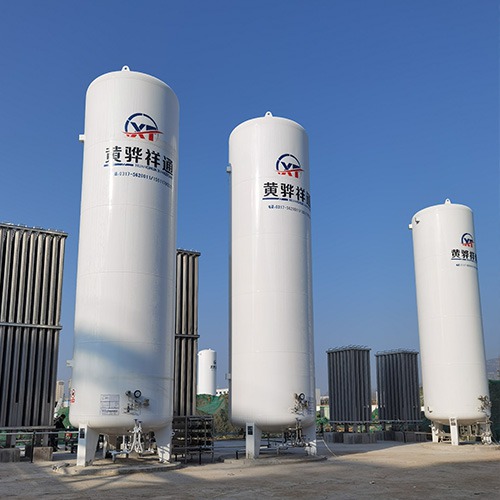
Sliding Supports: Incorporating sliding or movable supports at the base of the tank allows horizontal contraction without generating large stresses. Low-friction pads or rollers can accommodate movement.
Flexible Connections: Flexible joints for piping and instrumentation accommodate relative movement between the tank and support structure.
Expansion Loops in Piping: Pipes connected to the tank include expansion loops or bends to absorb thermal contraction and prevent stress on nozzles and welds.
Adjustable Skirt and Foundation Design: Skirt supports can be designed with adjustable bolts or spring elements to allow vertical and lateral contraction while maintaining tank stability.
Finite Element Analysis (FEA): Structural simulations help predict contraction effects and optimize support spacing, pad materials, and flexibility requirements.
3. Safety and Operational Considerations
Supports must maintain load-bearing capacity while allowing for thermal movement.
Preventing over-constraining the tank avoids local buckling, cracking of welds, or insulation damage.
Cold contraction compensation must be compatible with seismic and wind load requirements.
Conclusion
Designing cryogenic storage tank supports with effective cold contraction compensation ensures structural integrity, reduces stress concentrations, and allows safe operation at extremely low temperatures. A combination of sliding supports, flexible connections, and optimized structural design is essential to accommodate material contraction while maintaining tank stability.
References
EN 14620 – Design and Manufacture of Cryogenic Vessels.
API 620 – Design and Construction of Large, Welded, Low-Pressure Storage Tanks.
ASME Boiler and Pressure Vessel Code, Section VIII – Rules for Construction of Pressure Vessels.
Barron, R.F. (1999). Cryogenic Systems, 2nd Edition. CRC Press.
Bratt, R., & Mort, P. (2015). Cryogenic Engineering: Fifty Years of Progress. Springer.