








Storage methods and quality assessment of low-temperature storage tanks
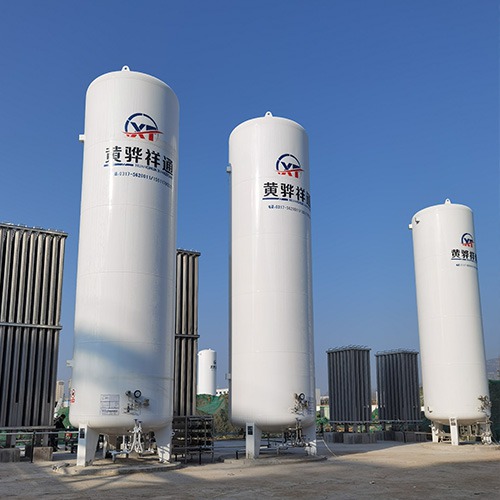
【1】 At present, there are three commonly used storage methods for low-temperature LNG tanks in many regions: atmospheric pressure storage, mother and child tank pressurized storage, and vacuum tank pressurized storage. The choice of storage method mainly depends on the size of the storage capacity. ① The vacuum tank is a double-layer metal tank, with the inner tank being a low-temperature resistant stainless steel pressure vessel, and the outer tank made of carbon steel material, filled with insulation material in the interlayer, and evacuated. The vacuum tank is transported to the site as a whole after the pressure test is completed in the factory. The total storage capacity of LNG is below 1000m ³, and multiple vacuum tanks are generally used for centralized storage. Currently, the single tank capacity of vacuum tanks used in China is relatively large, with a capacity of 150m ³. The process flow of vacuum tank is relatively simple. Generally, a booster is used to pressurize the storage tank, and the material flows into the gasifier by pressure without using power equipment, resulting in low energy consumption. Therefore, many small LNG gasification stations in various regions basically adopt the form of vacuum tanks. ② The inner tank of the mother tank consists of multiple low-temperature resistant stainless steel pressure vessels, while the outer tank is a large carbon steel container that covers multiple inner tanks. Insulation material is also filled between the inner and outer tanks, and dry nitrogen gas is introduced into the interlayer to prevent humid air from entering. The inner tank of the mother and child tank is manufactured and pressure tested in the factory before being transported to the site, while the outer tank is installed on site. For storage and distribution stations with storage capacities ranging from 1000m ³ to 5000m ³, mother and child tanks or atmospheric tanks can be selected for storage according to the situation. Due to the requirements of internal tank transportation, a single mother and child tank in China can reach 250m ³. The gasification process using mother and child tanks is roughly the same as that of vacuum tanks. Due to the need for nitrogen gas to pass through the interlayer, an additional liquid nitrogen device is added to the equipment. ③ The structure of atmospheric pressure tanks includes bimetallic tanks and outer tanks made of prestressed concrete structures; There are both above ground and underground tanks, and those below 20000m ³ are mostly bimetallic tanks. The inner and outer tanks of the atmospheric pressure tank are both installed and manufactured on site, with a long production cycle. The operating pressure of LNG low-temperature atmospheric pressure storage tank is 15KPa, and the operating temperature is -162 ℃. It is a flat bottomed double walled cylindrical tank. The tank body is composed of two layers, inner and outer, with an insulation structure between the two layers, serving as a cold insulation layer. The inner tank is used to store liquefied natural growth gas, while the outer shell plays a protective and cooling role. In order to reduce the transfer of external heat into the tank, the designed inner and outer tanks are separated and independent. The tank top is a self-supporting arch top, and the inner tank top has sufficient strength and stability to withstand external pressure caused by insulation materials and internal pressure generated by internal gases. The welded insulated gas cylinder storage tank uses pearl sand as the insulation material and is filled with dry nitrogen gas to protect the micro positive pressure of the interlayer. The insulation material is isolated from the atmosphere, avoiding the influence of atmospheric pressure or temperature changes and the entry of humid air into the insulation layer between the inner and outer tanks, increasing the service life of the insulation material and protecting and improving its effectiveness. When designing and manufacturing insulation structures, pay attention to using moisture-proof measures (based on actual reports). Through technical and economic comparison, the one-time investment of the low-temperature atmospheric pressure storage tank scheme is lower than that of the mother and child tank scheme, but the operating cost of the low-temperature atmospheric pressure storage tank scheme is much higher than that of the mother and child tank scheme. Although the one-time investment of the low-temperature atmospheric pressure storage tank scheme is low, there are the following problems in the scheme: ① Low temperature atmospheric pressure storage tanks are suitable for liquefaction plants and receiving terminal stations. Usually, low-temperature atmospheric pressure storage tanks are used in both liquefaction plants and receiving terminal stations. This is because the LNG storage tanks in the receiving terminal station have a large capacity (single tank volume greater than 50000 m ³), which cannot be achieved by other forms of storage tanks. The received liquid is transported by LNG tanker ships, and the storage tanks on LNG tanker ships are also in low-temperature atmospheric pressure form with little pressure change. And there is a BOG condensation device installed in the receiving terminal station, which can convert BOG back into LNG. Due to the existence of liquefaction methods in the liquefaction plant, the BOG generated during storage can be converted into production gas for liquefaction. Therefore, low-temperature and atmospheric pressure storage tanks are used, and the amount of BOG evaporation has little effect on it. Due to the fact that the LNG used on this site is transported by tanker trucks, which carry pressure, unloading it into low-temperature and atmospheric tanks will produce a large amount of gasification and BOG gas. Moreover, due to the fact that BOG is a normal pressure gas, the investment and operating costs of BOG compressors are high. The operating costs of LNG pumps have also increased. ② The complex low-temperature atmospheric storage tank system requires consideration of both the overpressure problem of the tank and the issue of tank emptying (forming negative pressure), requiring air replenishment measures. Therefore, multiple low-temperature regulating valves, breathing valves, etc. for incoming goods should be installed on the tank. An automatic dry powder fire extinguishing system and lifting device should also be installed on the top of the storage tank. Due to the general working pressure of 15KPa for low-temperature and atmospheric pressure storage tanks, in order to maintain this pressure, the pressure regulating valve of the tank needs to be frequently opened, and BOG gas is recovered to the liquefaction section or burned by the flare in the station. This site does not have such facilities. If low-temperature and atmospheric pressure tanks are used, only a portion of BOG can be compressed and transported to the pipeline network, while the rest must be released, which not only causes waste but also pollutes the environment. Alternatively, constructing a comparable BOG storage tank within the station for BOG storage would require a significant increase in investment. ③ LNG pumps need to be installed, and the requirements for LNG pumps are high. Due to the fact that the liquid stored in low-temperature and atmospheric storage tanks does not carry pressure, in order to meet the net positive suction head of the LNG pump, the foundation of the storage tank (elevated foundation) needs to be raised. And to prevent cavitation, the inlet pipe of the LNG pump should consider using a vacuum insulated pipe. ④ The construction period is long and maintenance is difficult. Both the inner and outer tanks of the atmospheric pressure tank are installed and manufactured on site, resulting in a longer production cycle. If the storage tank malfunctions, it needs to be completely shut down for maintenance. 【2】 Generally, when purchasing liquefied natural growth gas storage tanks, we expect to choose low-temperature storage tanks that will not have any quality issues during use. This requires us to observe the quality of the low-temperature storage tanks when selecting. If you don't know how to judge the quality of low-temperature storage tanks, you can take a look at some suggestions from the editor. The safety issue of low-temperature storage tanks is directly related to our physical health. How to judge the quality of plastic cans, what kind of plastic cans are environmentally friendly and safe, and what is the difference between unsafe low-temperature storage tanks and environmentally friendly low-temperature storage tanks? Manufacturers suggest using experimental methods to judge the quality of low-temperature storage tanks. Experiment: Burning Plastic Cups with Open Flames Experiment principle: Polyethylene can burn continuously, and during the combustion process, there will be continuous droplets of substance similar to burning candles, with a wax like odor. Polyvinyl chloride is non flammable and emits black smoke when burned, accompanied by a pungent odor and a green flame. Experimental progress: The environmentally friendly plastic can lid purchased from the supermarket can be lit with a lighter, and the flame turns yellow with continuous dripping of substances. The taste is similar to burning a candle. The ultra-thin low-temperature storage tank held in the mall will not continue to burn after being lit. The flame edge is green and accompanied by black smoke, and the smell is also very pungent. Generally, by following the above method, we can determine the quality of the low-temperature storage tank, so we don't have to worry about buying a low-quality low-temperature storage tank.