








Liquid Nitrogen Tank Price 2026: Sizes, Costs, and Budget Planning
By the Numbers: Liquid Nitrogen Tank Prices in 2026
Prices for liquid nitrogen storage equipment span roughly two orders of magnitude. A small laboratory dewar costs less than a professional camera. A large industrial bulk tank costs as much as a residential building. The reason for the range isn't mystery — it's specification. What follows is a practical framework for understanding where your application falls on this spectrum.
Category 1: Laboratory and Transport Dewars
Dewars are non-pressurized or semi-pressurized containers designed for storing and transporting smaller volumes of LN₂. They are the workhorses of laboratory biology, cryopreservation, and cold trap applications.
| Dewar Type | Capacity | Pressure Rating | Typical Price Range | Best For |
|---|---|---|---|---|
| Small lab dewar | 5–30 liters | Non-pressurized | $150 – $800 | Sample storage, laboratory use |
| Medium dewar | 30–100 liters | Non-pressurized | $600 – $2,500 | Biological sample banks, research labs |
| Pressurized transport dewar | 100–250 liters | Up to 2.2 bar | $2,000 – $8,000 | LN₂ distribution, cryogenic supply |
| Large cryogenic dewar (on wheels) | 250–500 liters | Up to 3.5 bar | $6,000 – $18,000 | Large labs, biotech, blood banks |
Category 2: Bulk Stationary Tanks
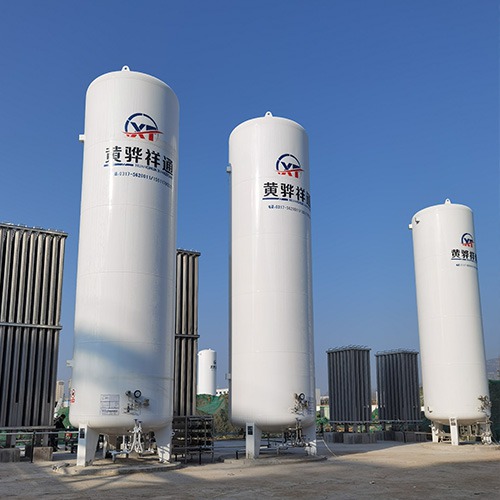
Bulk tanks are pressurized vessels designed for continuous supply applications. They connect to vaporizers and pressure regulation systems to deliver gaseous nitrogen on demand. This is where the price range becomes significant — and where specification choices have the most impact on cost.
| Tank Size | Working Pressure | Insulation Type | Certifications | Indicative Price |
|---|---|---|---|---|
| 1 m³ (1,000L) | 0.8 MPa | Vacuum + perlite | ASME | $12,000 – $22,000 |
| 3 m³ (3,000L) | 0.8–1.0 MPa | Vacuum + perlite | ASME | $18,000 – $32,000 |
| 5 m³ (5,000L) | 0.8–1.0 MPa | Vacuum + perlite | ASME | $25,000 – $42,000 |
| 10 m³ (10,000L) | 0.8–1.6 MPa | Vacuum + perlite | ASME / ASME+PED | $38,000 – $65,000 |
| 20 m³ (20,000L) | 0.8–1.6 MPa | Vacuum + perlite | ASME / ASME+PED | $55,000 – $95,000 |
| 50 m³ (50,000L) | 0.8 MPa | Vacuum + perlite | ASME+PED | $110,000 – $180,000 |
The Four Decisions That Drive Liquid Nitrogen Tank Price
Decision 1: Capacity
Capacity drives cost in a non-linear way. Doubling capacity does not double price — the relationship is roughly sub-linear for larger tanks because many fixed costs (engineering, certification, setup) are spread across more volume. A 5m³ tank costs more than five times a 1m³ tank, but less than five times the price.
For sizing, consider your consumption rate, delivery frequency, and storage buffer. Most industrial gas suppliers recommend a tank that runs 7–14 days between deliveries to balance inventory costs against delivery frequency.
Decision 2: Working Pressure
The most common pressure ratings for LIN tanks are 0.8 MPa, 1.0 MPa, and 1.6 MPa. Higher pressure tanks cost more due to thicker vessel walls. However, if you need high gas flow rates (for example, to supply a large purge system or high-speed freezer), the investment in a higher-pressure tank may be justified by reduced system complexity.
Most hospital and laboratory applications run adequately at 0.8 MPa. Industrial applications with high peak demand may require 1.0 or 1.6 MPa.
Decision 3: Insulation System
This is where the most important long-term cost trade-off occurs. Vacuum-insulated tanks cost more upfront but have boil-off rates of 0.1–0.3% per day. PUF-insulated tanks are cheaper but lose 0.5–1.0% per day. On a 5m³ tank running at $0.30 per liter of LN₂, a 0.7% daily boil-off difference costs approximately $4,000 per year in lost product — a difference that compounds over a 20-year tank life.
Vacuum insulation is the industry standard for any tank larger than approximately 1m³ that sees regular use. PUF tanks are occasionally used for very large LNG storage where the boil-off gas is recovered and used as fuel.
Decision 4: Certification Scope
ASME certification is the baseline for most markets. Adding PED CE marking (for European sales) adds approximately 10–15% to the price due to additional engineering documentation and third-party audit requirements. For buyers who need both certifications, the premium is worth it — a dual-certified tank has access to essentially every major market globally.
Total Cost of Ownership: Beyond the Purchase Price
A liquid nitrogen tank has ongoing costs that should be factored into your budget from the start:
Annual Cost Estimate for a 5m³ LIN Tank
How to Budget for Your Liquid Nitrogen Tank Purchase
Follow this checklist to build an accurate budget:
Define the application precisely: Gas type (LIN, LOX, LAR — the tank specification is similar), flow rate requirement (determines pressure and vaporizer sizing), and daily consumption (determines tank size and delivery frequency)
Identify required certifications: ASME for most markets; add PED if selling into Europe; add ADR/DOT for transport tanks
Clarify what is included: Tank only, tank plus vaporizer, tank plus full instrumentation — these are different price points
Get three comparable quotations: Same specifications from three manufacturers will give you a reliable market price range
Factor in logistics: For international buyers, ocean freight, port handling, customs clearance, and import duties can add 10–20% to the landed cost
Frequently Asked Questions
Small laboratory dewars (10–50L) cost $200–$1,500. Transport dewars (100–250L) range from $1,500–$8,000. Small bulk tanks (1–5m³) start at $12,000 and go up to $40,000. Large industrial tanks (20–60m³) range from $60,000–$200,000. Prices depend on capacity, pressure rating, insulation type, and certifications.
Most hospitals use 5–20m³ LIN/LOX tanks. A 5m³ tank holds approximately 4,000 liters and typically serves a 200–500 bed hospital for several weeks between deliveries. Your gas supplier usually specifies the tank size as part of the supply contract.
For tanks storing LIN, LOX, or LAR at similar temperatures, the tank price is essentially the same. LNG (-162°C) and LH₂ (-253°C) tanks require different specifications and cost more. LCO₂ tanks operate at higher pressures and have different designs.
Beyond purchase price, annual costs include: PRV inspections ($400–$800), periodic vacuum checks ($300–$700), maintenance ($300–$1,000), and boil-off losses (a 0.3% daily rate on a 5m³ tank costs ~$500/year at $0.25/L). Total annual operating costs typically run $1,200–$5,500+ depending on tank size and usage.