








Horizontal vs Vertical Cryogenic Tanks: When and Why to Choose Horizontal
The Orientation Decision That Affects Everything Else
For most of the history of cryogenic storage, the question of whether to use a vertical or horizontal tank was a secondary one — you bought what the manufacturer made, and if your site had constraints, you worked around them. That is no longer the case. Modern cryogenic tank manufacturers offer both orientations as standard options, and the choice between them is now a genuine design decision that affects site layout, foundation design, equipment room configuration, and long-term operational convenience.
The right answer depends entirely on the specific site. There is no universal preference — what is clearly correct for one facility may be clearly wrong for another. This article lays out the technical considerations so that buyers and specifiers can make an informed decision rather than defaulting to convention.
Comparing Footprints for a 50m³ LNG Tank
| Parameter | Vertical 50m³ LNG Tank | Horizontal 50m³ LNG Tank |
|---|---|---|
| Approximate diameter | 2,600 mm | 2,600 mm |
| Approximate overall height | 9,500–10,500 mm (tank + legs + valve cabinet) | 2,800–3,200 mm (tank + saddle height) |
| Approximate length | 2,600 mm | 10,000–11,000 mm |
| Footprint (m²) | 6.8 m² | 26–30 m² |
| Required clearance above | ~3 m for maintenance access | ~1.5 m above tank dome |
| Foundation type | Concrete pad, concrete ring beam, or pile foundation | Continuous concrete sill beams or pile cap foundation |
| Suitability for indoor installation | Limited — requires tall room | Good — fits standard industrial building heights |
Side-by-Side Decision Guide
✅ Choose Vertical When:
✅ Choose Horizontal When:
Installation and Foundation Considerations
Vertical Tank Foundation
A vertical cryogenic tank's weight (tare weight plus contents) is concentrated at a small footprint area. For a 50m³ vertical LNG tank, the tare weight is approximately 9,000–12,000 kg, and the full-load weight is approximately 31,000 kg, all concentrated in a footprint of approximately 2.6m × 2.6m. The foundation must resist the overturning moment from wind loading on the tall tank body — this typically requires a concrete ring beam foundation, a pile cap, or a massive concrete pad with sufficient mass to resist tipping.
Horizontal Tank Foundation
A horizontal cryogenic tank distributes its load across a much larger footprint — the tank's full length (10–12m for a 50m³ horizontal tank) bears on saddle supports that transfer the load to the foundation. Foundation requirements for horizontal tanks are typically sill beam foundations — continuous concrete strips under each saddle support — rather than a single pad. The foundation must be level and stiff enough to prevent differential settlement that could induce stresses in the tank shell.
Level Measurement in Horizontal Tanks
One of the practical complexities of horizontal cryogenic tanks is level measurement. In a vertical tank, the liquid surface is a flat horizontal plane at any fill level, and a simple differential pressure transmitter or float gauge gives an accurate volume reading. In a horizontal tank, the liquid surface is a flat horizontal plane, but the tank's cross-section is circular — which means that for the first portion of the fill, the liquid level only covers the lower portion of the circular cross-section. A horizontal tank has a non-linear volume-to-height relationship that changes with fill level.
Modern electronic level measurement systems handle this with a tank geometry calibration curve — the transmitter converts the measured liquid height to a volume using a mathematical model of the tank's shape. This calibration must be performed after installation (when the tank geometry is finalized) and after any work that might affect the tank's internal geometry. This is not a reason to avoid horizontal tanks — but it is a reason to specify accurate level measurement instrumentation and to verify the calibration after installation.
Common Applications by Orientation
| Application | Typical Orientation | Reason |
|---|---|---|
| Industrial gas distribution plants | Vertical | Multiple tanks on compact outdoor pads, standard site layouts |
| LNG peak shaving stations | Vertical | Large tanks, outdoor sites, multiple units in parallel |
| Hospital medical gas systems (LIN) | Horizontal | Often installed in equipment rooms with limited height |
| Food processing CO2 storage | Horizontal | Standard-height utility buildings, multiple tanks per room |
| Steel mill LAR supply | Vertical | Large outdoor installation, high daily consumption |
| Small-scale LNG fueling stations | Horizontal | Urban sites with height and space constraints |
| Electronics manufacturing (specialty gases) | Horizontal or vertical | Depends on available equipment room geometry |
Frequently Asked Questions
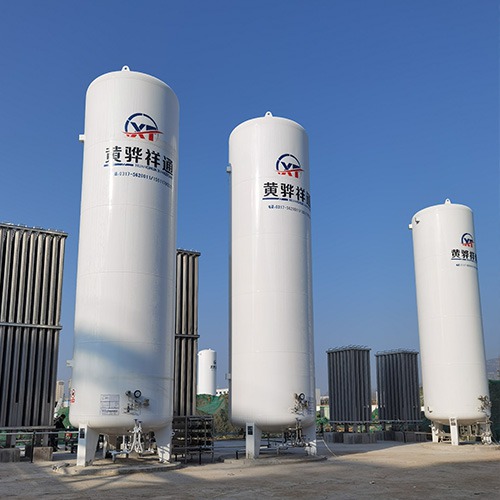
A vertical tank stands on support legs with its axis perpendicular to the ground — taller than wide. A horizontal tank lies on its side — wider than tall. Both are identical in inner technology (double-wall vacuum-insulated pressure vessels). The orientation affects footprint, foundation requirements, and level measurement complexity. Both orientations are available from XT Cryogenic Tank in capacities from 5m³ to 250m³.
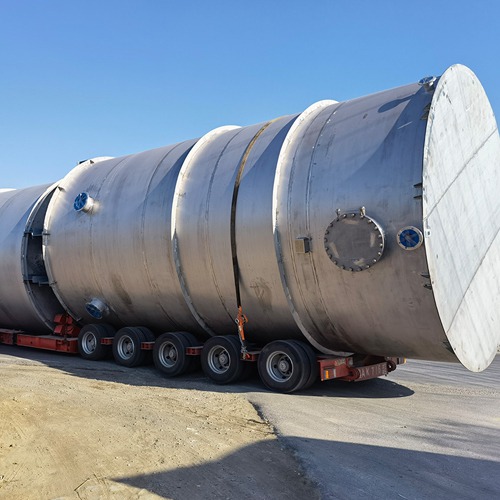
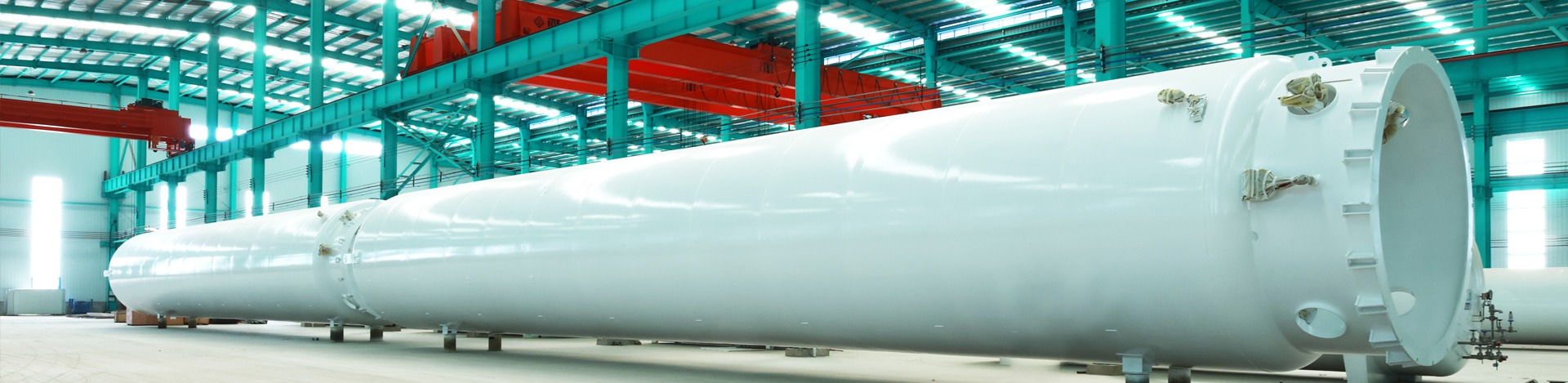
Horizontal tanks have a lower profile, making them practical in facilities with height restrictions — indoor installations, sites under power lines, or buildings with standard ceiling heights. For very large tanks (100m³+), horizontal orientation may be the only practical option given site geometry. The larger liquid surface area at partial fill can also benefit certain gas consumption applications.
Vertical tanks have a smaller footprint — they take up less horizontal floor space. This matters in crowded industrial plants and urban facilities. The vertical pressure vessel design is also structurally simpler and more efficient. For most standard applications, vertical is the default unless site geometry dictates otherwise.
In a vertical tank, the liquid-vapor interface is always horizontal, so a simple float or differential pressure gauge gives accurate volume. In a horizontal tank, the interface is still horizontal but the tank cross-section is circular — creating a non-linear volume-to-height relationship that requires a calibrated electronic level system with tank geometry correction. This adds complexity but is well within standard instrumentation capability.
Yes — this is one of the primary advantages of horizontal tanks. A horizontal 50m³ LNG tank has a total height of approximately 2.8–3.2m, fitting within standard industrial building heights of 4–6m. Indoor installation provides weather protection, reduced temperature extremes, and improved security. Mandatory requirements include adequate ventilation for cryogenic liquid service and appropriate fire safety provisions.