








Vacuum Powder Insulation Technology in Cryogenic Tanks: How It Works
The Problem of Keeping Something at -162°C in 35°C Summer Heat
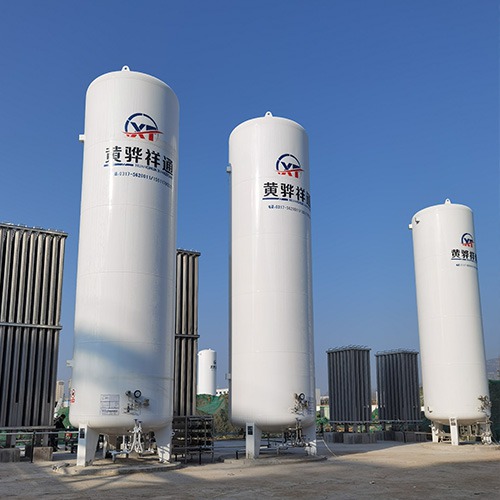
Consider a 50m³ LNG storage tank sitting in a Chinese industrial facility in August. The ambient temperature is 35°C. Inside the tank is liquefied natural gas at -162°C. The temperature difference across the tank wall is nearly 200°C. Left to itself, heat would flow from the warm air through the tank wall and into the LNG, causing it to boil and vaporize. Without effective insulation, a tank of this size might lose 5–10% of its contents per day to boil-off. At that rate, a full tank would be empty in 10–20 days.
Vacuum powder insulation solves this problem. By creating a near-perfect vacuum between two concentric shells and filling the space with a light, porous powder, the rate of heat flow into the cryogenic liquid is reduced to the point where boil-off is manageable — typically 0.05–0.2% per day. This is the technology that makes long-term cryogenic storage of LNG, LOX, LIN, LAR, and LCO2 practical and economically viable.
How Heat Flows Into a Cryogenic Tank
To understand insulation, you first need to understand the three mechanisms of heat transfer that operate in a cryogenic tank:
Conduction through the tank wall materials: stainless steel inner tank and carbon steel outer shell conduct heat from the warm outer surface to the cold inner surface. This cannot be eliminated, only minimized by using thin walls.
Convection within the cryogenic liquid and in the gas space above it: internal convection helps distribute heat from boil-off gas but does not contribute significantly to heat ingress from outside.
Radiation across the vacuum space: electromagnetic radiation (infrared) from the warm outer shell travels across the vacuum space and is absorbed by the cold inner shell. Radiation is significant in vacuum insulation and is managed by using low-emissivity inner surface coatings.
In vacuum powder insulation, the evacuated powder space eliminates gas convection (no gas molecules to move heat) and dramatically reduces gas conduction (no gas molecules to transfer kinetic energy). Solid conduction through the perlite particle contact points and radiation across the void spaces remain, but both are very small in a properly evacuated system.
The Three Regimes of Vacuum Powder Insulation
Atmospheric Pressure Perlite (no vacuum)
Thermal conductivity: 0.034–0.052 W/(m·K). This is what you would get with just perlite powder at atmospheric pressure filling the annulus. The gas in the void spaces between perlite particles dominates heat transfer. Boil-off rate would be approximately 2–5% per day for a 50m³ LNG tank — too high for practical long-term storage but useful for some short-term applications.
Coarse Vacuum (10⁻¹ to 10⁻² Pa)
Thermal conductivity: 0.003–0.010 W/(m·K). At this vacuum level, gas conduction is significantly reduced but not eliminated. Some gas molecules remain in the annulus and conduct heat. This is the minimum acceptable vacuum for a useful insulation system. Boil-off rate approximately 0.3–1.0% per day. Many older or lower-quality cryogenic tanks operate in this regime.
Deep Vacuum (10⁻³ to 10⁻⁶ Pa)
Thermal conductivity: 0.001–0.005 W/(m·K). This is the target for high-quality cryogenic tank insulation. At this vacuum level, gas conduction is negligible. Heat transfer is dominated by solid conduction through perlite particle contacts and radiation across void spaces. Boil-off rate approximately 0.05–0.2% per day. XT Cryogenic Tank specifies a sealing vacuum of ≤2×10⁻⁸ Pa for all cryogenic storage tanks.
Perlite: The Insulation Powder
Perlite is the most widely used insulation medium for large stationary cryogenic tanks. It is produced from naturally occurring volcanic glass (obsidian) that contains 2–5% water. When rapidly heated to 850–1,100°C, the water in the glass vaporizes and expands the material to 4–20 times its original volume, producing a white granular material with a closed-cell structure.
Key properties of perlite that make it the preferred insulation medium:
Non-toxic and chemically inert at cryogenic temperatures
Non-flammable — does not contribute to fire hazards
Resistant to radiation damage (important in some specialty applications)
Available globally and inexpensive
Can be poured into annular spaces without special equipment
Retains its properties after long-term vacuum exposure
What Determines the Heat Leak Rate of a Cryogenic Tank
| Factor | Effect on Heat Leak | Design Action |
|---|---|---|
| Vacuum level in annulus | Lower pressure = less gas conduction = lower heat leak | Achieve and maintain deep vacuum; monitor with vacuum gauge |
| Perlite quality and particle size | Properly graded perlite = optimal void structure = lower heat leak | Specify quality perlite; control particle size distribution |
| Annulus spacing | Wider annulus = more perlite = more solid conduction = higher heat leak | Optimize annulus width; thicker insulation adds cost but reduces heat leak |
| Inner tank surface emissivity | Lower emissivity inner surface = less radiation = lower heat leak | Use low-emissivity polish or coating on inner shell |
| Temperature difference | Larger ΔT = more radiation and conduction = higher heat leak | Cannot change this; design must accommodate maximum ambient temperature |
| Tank size (surface area) | Larger tanks have more surface area but lower heat leak per unit volume (volume-to-surface ratio improves) | Economies of scale favor larger tanks for lower per-m³ heat leak |
Vacuum Degradation: Why Insulation Gets Worse Over Time
Even with excellent initial vacuum, the insulation quality in a cryogenic tank gradually degrades. This is not a manufacturing defect — it is a physical inevitability for any system that relies on maintaining a vacuum over decades of service. Understanding the degradation mechanism helps operators plan for maintenance.
The primary mechanism is gas leakage through microscopic paths in the tank welds, flanges, and penetrations. Every weld has some microporosity; every valve stem has a clearance fit; every threaded connection has some imperfection. Over time, air and moisture migrate through these paths into the vacuum space. Because the vacuum space is sealed and the volume is large, this ingress is very slow — a tank might take 15–25 years to degrade to an unacceptable vacuum level. But the process is irreversible: once air and moisture are in the annulus, they cannot be removed without re-evacuation.
Re-Evacuation: Extending Tank Life
When vacuum degradation reaches an unacceptable level, the tank can be re-evacuated by connecting an external vacuum pump to the annulus connection. The process involves:
Connecting vacuum pump to the tank's vacuum monitoring connection
Heating the tank contents gently to drive off adsorbed moisture from the perlite (optional but recommended for best results)
Running the vacuum pump continuously for 5–15 days depending on tank size and degree of degradation
Monitoring the vacuum gauge — a return to deep vacuum (≤10⁻³ Pa) indicates successful re-evacuation
Sealing the vacuum connection
Re-evacuation typically costs 10–20% of a new tank and can extend the useful life of a cryogenic tank by another 10–15 years. For a well-maintained tank, this economic calculation almost always favors re-evacuation over replacement.
Frequently Asked Questions
Vacuum powder insulation uses a vacuum space between two concentric shells filled with perlite powder. By evacuating to deep vacuum (10⁻³ to 10⁻⁶ Pa), the thermal conductivity drops to 0.001–0.005 W/(m·K) — about 5% of still air. This reduces the heat leak rate to a manageable 0.05–0.2% of tank capacity per day, making long-term cryogenic storage practical. Without vacuum powder insulation, boil-off rates would be 10–50× higher.
Perlite is expanded volcanic glass — produced by heating volcanic glass to 850–1,100°C where it expands to 4–20× its original volume. The resulting porous, lightweight granules have excellent insulating properties under vacuum. It is used because it is inexpensive, non-toxic, non-flammable, chemically inert, and retains its properties under long-term vacuum. Perlite is sieved to a specific particle size range (0.3–1.5 mm) for optimal insulation performance.
Two mechanisms: vacuum degradation from slow air and moisture ingress through micro-leaks in welds and penetrations over 15–25 years; and perlite deterioration from settling under gravity (creating voids) and moisture adsorption. Both mechanisms raise the heat leak rate until the boil-off rate becomes economically significant. The process is gradual and detectable via the thermocouple vacuum gauge.
The inner tank is assembled and pressure-tested, then the outer shell is fitted around it. Perlite is poured into the annular space through filling ports at multiple levels for even distribution. The annulus is then sealed and connected to a vacuum pump. Evacuation runs for several days while the tank is heated gently to drive off moisture. The process continues until vacuum stabilizes at the design level (≤2×10⁻⁸ Pa for XT tanks).
A well-manufactured cryogenic tank with vacuum powder insulation typically maintains satisfactory insulation performance for 15–25 years before re-evacuation is needed. Excellent manufacturing quality can extend this to 20–30 years. Regular vacuum monitoring via the thermocouple vacuum gauge allows operators to track performance and plan refurbishment before boil-off becomes unacceptably high.