








LNG Peak Shaving Stations: Storage Tank Design for Seasonal Gas Demand Balancing
The Problem That Makes Peak Shaving Necessary
Urban natural gas demand is not constant. It follows a pattern driven by weather, economic activity, and daily rhythms. On a mild August day, a city gas network serving 2 million households might need 5 million cubic meters of natural gas per day. On a cold January day, the same network might need 18 million cubic meters per day — three and a half times as much — because heating systems are running, water heaters are working harder, and commercial heating loads are at their peak.
Pipeline gas supply has some flexibility, but not enough to cover a 3× swing in demand. Pipeline operators can increase throughput somewhat by compressing gas harder, but they cannot run gas at 350% of their rated capacity. The solution is to fill the gap with stored LNG — buying gas in summer when it is cheap and abundant, liquefying it, and storing it, then regasifying it in winter when demand exceeds pipeline capacity. This is peak shaving. And the peak shaving storage tank is the physical infrastructure that makes the whole system work.
The Seasonal Cycle of a Peak Shaving Station
LNG Receiving and Filling
During summer months when demand is low and LNG prices are typically lower, the peak shaving station receives LNG by road tanker. Each tanker carries 30–50m³ of LNG. Filling operations transfer LNG from the tanker to the storage tanks using cryogenic flexible hoses and the tanker's built-in pumping system. A typical station with 4× 100m³ tanks might receive 20–30 road tanker deliveries over the summer to fill to working capacity. Tanks are filled to 85–90% of capacity, leaving ullage for thermal expansion.
Pre-Winter Preparation
Before the heating season begins, the station team performs pre-winter maintenance: pressure checks on all tanks, verification of pressure relief valve settings, inspection of vaporizer systems and send-out pipelines, calibration of flow meters, and verification of emergency shutdown systems. The boil-off gas management system is checked — tanks that have been sitting full for months must be evaluated for any pressure increase indicating vacuum degradation.
Active Regasification and Send-Out
When cold weather drives demand above pipeline capacity, the peak shaving station activates. Cryogenic pumps draw LNG from storage tanks, pass it through regasification vaporizers, and inject regasified natural gas into the city gas pipeline at the required pressure. Send-out rates during peak demand days can be 500,000–2,000,000 m³/day depending on the station's capacity. A station with 4× 100m³ tanks (approximately 80 tonnes of LNG each at 90% fill) can provide 10–20 days of peak send-out depending on the draw rate.
Post-Winter Assessment and Tank Standby
After the heating season ends, tanks may be kept partially filled in standby for shoulder-season demand fluctuations, or emptied and taken offline for inspection. The decision depends on whether the utility expects demand spikes in spring or autumn. Tanks may be inerted with nitrogen vapor in the ullage space if they will be standing empty for an extended period to prevent air ingress and moisture adsorption by the insulation.
Storage Tank Specifications for Peak Shaving Applications
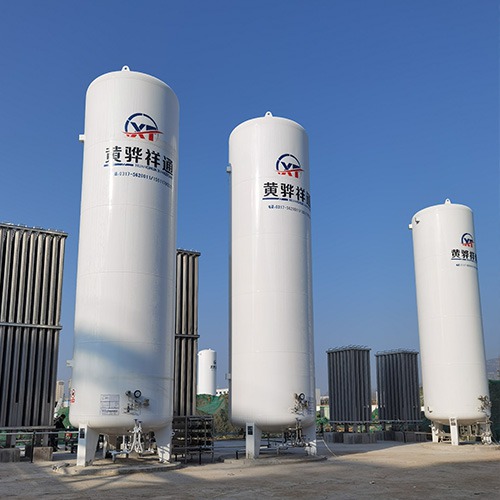
Peak shaving storage tanks are the largest stationary cryogenic storage tanks in the gas distribution chain. They are subject to demanding requirements: large capacity, high reliability (cannot fail during a winter peak event), long service life (20–30 years), and the ability to sit for months at a time without significant boil-off loss.
| Parameter | Typical Peak Shaving Tank Spec | Standard Small Tank (comparison) |
|---|---|---|
| Capacity Range | 50–250 m³ per tank | 5–30 m³ per tank |
| Working Pressure | 0.8 / 1.2 MPa | 0.8 / 1.2 / 1.6 MPa |
| Inner Tank Material | S30408 stainless steel | S30408 stainless steel |
| Outer Shell Material | Q345R carbon steel | Q245R carbon steel |
| Insulation | Vacuum powder perlite, deep vacuum | Vacuum powder perlite |
| Expected Service Life | 20–30 years | 15–20 years |
| Boil-Off Rate Target | <0.05% per day | <0.1% per day |
| Fill Level Control | Automated, with high-level alarm and shutoff | Manual or semi-automatic |
| Monitoring | Continuous vacuum monitoring, PLC control system | Local gauges, manual reading |
How Much Storage Does a City Gas Network Need?
Note: 2,000m³ tanks are very large and may require custom engineering. In practice, most peak shaving stations use multiple smaller tanks (100–150m³ units) in parallel to provide the same total storage with better operational flexibility and easier maintenance.
Regasification: From -162°C Liquid to Pipeline Gas
The regasification system is the second critical component of a peak shaving station, after the storage tanks. LNG leaves the storage tank as a liquid at -162°C and 0.8–1.2 MPa and must be heated to above 0°C and compressed to pipeline pressure (typically 0.4–1.6 MPa depending on the network).
Vaporizer types used at peak shaving stations:
Ambient air vaporizers: Use ambient air to heat LNG through aluminum or stainless steel heat exchange surfaces. In temperate climates, they are the most economical option. In very cold climates (-20°C or below), they ice up rapidly and lose effectiveness.
Water bath vaporizers: Heat LNG using warm water circulated by gas-fired or steam-heated boilers. More expensive to operate but reliable in all climates. The water bath prevents ice formation that plagues air vaporizers in cold weather.
SCV (Submerged Combustion Vaporizer): Directly fires combustion gases into a water bath to heat it — highly efficient and reliable but more complex. Used at larger terminals and in cold climates.
Safety Considerations Unique to Peak Shaving Stations
Key safety systems required at peak shaving stations:
LNG leak detection using catalytic bead sensors or IR open-path detection covering all tank areas, pipework, and pump sumps
Emergency shutdown (ESD) system that can be activated from the control room and manually at the tank area — closes primary and secondary LNG shutoff valves
Firewater system covering all tank areas, sized for the largest credible LNG fire scenario (typically a pool fire from a full-bore tank rupture)
Dike/impoundment area around each tank, sized to contain the full tank inventory in case of catastrophic leak — required under most jurisdictions
High-high level instrumentation on tanks that automatically stops filling if the liquid level exceeds 90% (thermal expansion protection)
Pressure monitoring with alarms at 80% and 90% of the pressure relief valve set point
Frequently Asked Questions
Natural gas demand can be 3× higher in winter than summer due to heating loads. Pipeline supply has limited flexibility to follow these swings. LNG peak shaving stores large volumes of LNG during low-demand summer months, then regasifies and injects them into the city gas network during peak winter demand. Without peak shaving, cities would face gas shortages on the coldest winter days.
Peak shaving LNG storage tanks range from 50m³ to 250m³ per unit. A medium-sized city gas network might need 2–4 tanks of 100–150m³ each, providing 1–2 million m³ of regasified natural gas over a winter season. Large metropolitan peak shaving stations can have 200–250m³ tanks with 4–8 tanks on site.
A peak shaving station primarily receives LNG by road tanker and stores it for later regasification. A small-scale LNG terminal has marine receiving infrastructure (a jetty or berth) for receiving LNG from LNG carriers. Many facilities perform both functions; the distinction is mainly about the primary supply route.
LNG is pumped from storage tanks through vaporizers that heat it from -162°C to above 0°C, then the gas is compressed to pipeline pressure and injected into the city gas network. Common vaporizer types include ambient air vaporizers (economical in temperate climates), water bath vaporizers (reliable in cold climates), and submerged combustion vaporizers (high capacity, all climates).
Large LNG inventories mean significant vapor cloud hazards — requiring careful siting relative to property boundaries and occupied buildings. Boil-off gas management is critical during long storage periods. Firewater supply must be sized for major LNG fire scenarios. LNG release modeling and hazard zone delineation are typically required as part of the permitting process for urban-area stations.