








Liquid CO2 Storage Tanks: The High-Pressure Cryogenic Tank for Food and Industrial Use
Why Your CO2 Tank Works Harder Than Your LNG Tank
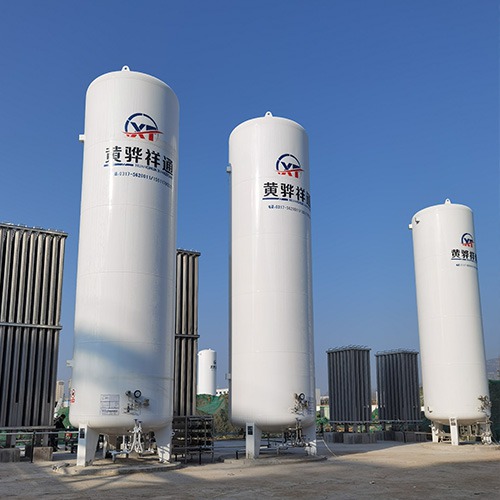
If you set a 20m³ LNG storage tank and a 20m³ LCO2 storage tank next to each other, they look similar — double-wall vacuum-insulated cryogenic pressure vessels, similar dimensions, similar valve arrangements. But the LNG tank is operating at 0.8 MPa and -162°C. The LCO2 tank is operating at 2.16 MPa and -40°C. These are completely different service conditions, and understanding why is the key to understanding LCO2 storage.
CO2 is thermodynamically unusual. Its triple point — where solid, liquid, and gas phases coexist in equilibrium — occurs at 5.18 bar and -56.6°C. Below this pressure and temperature, CO2 cannot exist as a liquid at all; it is either dry ice or gas. This is fundamentally different from LNG, LOX, and LIN, which can all be stored as liquids at atmospheric pressure at their respective boiling points. CO2 must always be stored under pressure — which is why LCO2 tanks are classified as medium-pressure vessels (1.6–10 MPa range) rather than the low-pressure classification used for most other cryogenic tanks.
The CO2 Phase Diagram: Why CO2 Storage Is Different
LCO2 Tank Specifications: What Makes Them Different
| Parameter | LCO2 Tank (XT Cryogenic) | LNG Tank (for comparison) | Significance |
|---|---|---|---|
| Working Medium | Liquid CO2 (LCO2) | Liquefied Natural Gas | Different thermodynamic properties |
| Working Temperature | -30°C to -40°C | -162°C | LCO2 is warmer but requires higher pressure |
| Design Working Pressure | 2.16 MPa | 0.8 / 1.2 / 1.6 MPa | LCO2 needs significantly higher pressure |
| Inner Tank Material | 16MnDR carbon steel | S30408 stainless steel | 16MnDR adequate for LCO2 at -40°C |
| Outer Shell Material | Quality carbon steel | Q245R / Q345R | Structural jacket, same principle |
| Insulation Type | Vacuum powder (perlite) | Vacuum powder (perlite) | Same insulation technology |
| Sealing Vacuum | ≤ 2×10⁻⁸ Pa | ≤ 2×10⁻⁸ Pa | Same vacuum standard |
| Capacity Range | 5–200 m³ | 5–250 m³ | Similar size range |
Applications: Where LCO2 Tanks Are Used
Beverage Carbonation
This is the largest food-grade LCO2 application. Every carbonated soft drink, beer, sparkling water, and cider relies on dissolved CO2 to create bubbles and the characteristic mouthfeel. A large soft drink bottling plant consuming 100–200 tonnes of CO2 per month needs 30–60m³ of on-site LCO2 storage, filled by bulk CO2 tanker every 5–10 days. The CO2 must be food-grade (4.0N minimum purity) with a COA from the supplier.
Food Processing and Preservation
CO2 is used in modified atmosphere packaging (MAP) — replacing oxygen in food packaging with CO2 (and typically N2) to slow microbial growth and oxidation. It is also used in cryogenic food freezing (as dry ice or liquid CO2 spray) and in pH control in beverage production. A large-scale food processor might need 10–30m³ of LCO2 storage.
Dry Ice Production
Liquid CO2 is the feedstock for dry ice (solid CO2) production. Dry ice is used for cryogenic cleaning in manufacturing, transport of temperature-sensitive medical and biological products, and food cold chain applications. Dry ice plants typically need dedicated LCO2 storage — often 20–50m³ — with dedicated pressure regulation to feed the dry ice block-making equipment.
Water Treatment and pH Control
CO2 is increasingly used in water treatment as an alternative to mineral acids (sulfuric acid, hydrochloric acid) for pH adjustment. CO2 dissolves in water to form carbonic acid, which lowers pH without introducing problematic anions. This application is growing in municipal water treatment and industrial process water treatment.
Tank Sizing Calculator
How to Size an LCO2 Tank
| Facility Type | Typical CO2 Consumption | Suggested Tank Size | Delivery Frequency |
|---|---|---|---|
| Small craft brewery | 50–200 kg/month | 1–3 m³ | Monthly |
| Mid-size beverage plant | 5–20 tonnes/month | 5–10 m³ | Bi-weekly |
| Large soft drink bottler | 50–200 tonnes/month | 30–60 m³ | Weekly |
| Dry ice production facility | 10–50 tonnes/month | 20–50 m³ | Weekly |
| Large food processor (MAP) | 5–30 tonnes/month | 10–30 m³ | Weekly–bi-weekly |
Safety: CO2 Asphyxiation Hazards
CO2 concentrations above 5% (50,000 ppm) cause dizziness, headache, and impaired cognition. Concentrations above 10% cause rapid unconsciousness and death within minutes. Because CO2 is invisible and has no odor, workers may not realize they are being exposed. This is why oxygen depletion monitoring is mandatory in any enclosed space where LCO2 is stored or used. CO2 is heavier than air (vapor density 1.52 vs air = 1.0) — it accumulates at floor level and in low-lying areas like basements, trenches, and pits.
Required safety provisions for LCO2 storage installations:
Oxygen depletion monitor (ODM) with alarm in any enclosed LCO2 storage area, mandatory under most building codes
Mechanical ventilation in LCO2 storage rooms, sized for worst-case leak scenario (1 ACH minimum recommended)
CO2 leak detection system with automatic alarm and — ideally — automatic ventilation activation
Emergency shut-off valves at the tank and at the building entry point
Clear evacuation procedures posted at the LCO2 storage area, including the specific hazard of low-lying CO2 accumulation
Pressure relief valve discharge piping routed to a safe location away from personnel access areas
Frequently Asked Questions
CO2's triple point (5.18 bar, -56.6°C) means it can only exist as a liquid above that pressure and temperature. Unlike LNG or LIN, which can be stored at near-atmospheric pressure, CO2 requires 2.0–2.4 MPa to remain liquid at practical storage temperatures of -20°C to -30°C. This is why LCO2 tanks have a design pressure of 2.16 MPa — significantly higher than the 0.8–1.6 MPa used for LNG tanks.
Food-grade CO2 requires minimum purity of 90% (3.0N) for most food applications and 90% (4.0N) for beverage carbonation, with strict limits on water, oil, and hydrocarbon contaminants. Food-grade CO2 must be produced under GMP conditions with a Certificate of Analysis. Tanks that have held industrial CO2 must be purged and verified before switching to food-grade product.
Consumption ranges from 50–200 kg/month for a small craft brewery to 50–200 tonnes/month for a large soft drink bottler. This drives tank sizing from 1–3 m³ for small breweries to 30–60 m³ for large beverage plants.
Oxygen depletion monitoring is mandatory in any enclosed LCO2 storage space. CO2 concentrations above 5% cause impaired cognition; above 10% it causes rapid unconsciousness and death. Confined space entry procedures, mechanical ventilation, CO2 leak detection with automatic alarms, and pressure relief discharge routing to safe locations are all required safety provisions.
Required capacity = (Daily consumption × delivery interval) / (0.9 × 1,000 kg/m³). Example: 300 kg/day × 14-day delivery = 4,200 kg → 4,200 / 900 = 4.67 m³ → round up to 5 m³ standard size.