








Transportation, lifting, and cleaning specifications for low-temperature storage tanks
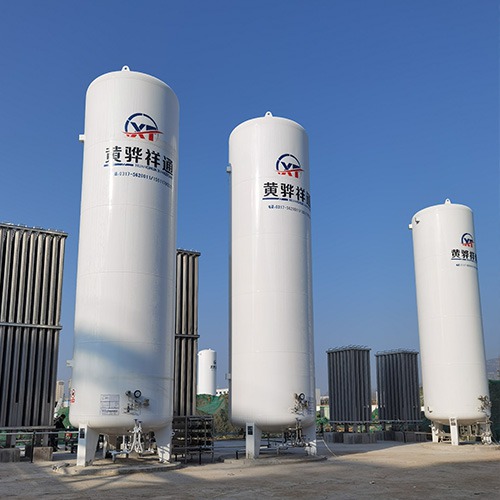
{1} 1. Advantages of Low Temperature Storage Tanks: Previously, we mostly used pressure devices to store gases, but this method has two obvious disadvantages: it requires a large pressure, which makes the equipment exist in danger for a long time; Due to the limited pressure, it is difficult to build high-pressure vessel equipment with a large volume. Low temperature storage tanks precisely overcome these two drawbacks. At low temperatures, gases naturally become liquid, and the pressure is only at atmospheric pressure or slightly higher than atmospheric pressure. Combining these advantages, the development space for low-temperature storage tanks is very large. In the storage industry, its position is certain. Currently, most coastal areas in China, such as Zhanjiang and Dalian, have begun to build LNG storage tanks. It is also being applied in the transportation industry, with a typical example being low-temperature transport ships. A low-temperature storage tank is actually a tank with a thick insulation layer, equivalent to a large refrigerator. After compressing, cooling, and liquefying the gas through a compressor, it is stored in a low-temperature storage tank. When applied, it is heated to make it gaseous and supplied to users for use. 2. The classification of low-temperature storage tanks is based on the medium: LPG (liquefied petroleum gas), LNG (liquefied natural growth gas); Classified by location: aboveground type, underground type Classified by structure: inner tank+insulation+metal shell; Inner tank+insulation+concrete shell; Inner tank+insulation; Inner tank+insulation+metal shell+concrete shell. {2} For low-temperature pressure vessels, besides the quality of liquefied natural growth gas storage tanks, what people are more concerned about is the price of low-temperature storage tanks. So, let's talk about what determines the price of low-temperature storage tanks? Because low-temperature storage tanks are special equipment, they need to be repaired and cleaned after a period of use. Some low-temperature storage tanks require cleaning personnel to do the cleaning work and remove scale. Firstly, it is necessary to check the pressure gauge and water level gauge, mainly to observe whether there is any abnormality in the display on the water level gauge, and whether the entire state of the drain valve in the column on the water level gauge is correct. Secondly, it seems that the pressure gauge is still within the deadline and whether the prescribed inspection marks are intact. It also seems that there are no other abnormalities, such as bending of the pipeline or whether the installation of the connecting pipe is firm, and whether there are any abnormalities in the opening and closing of the middle valve. Then it is necessary to check the discharge valve, discharge pipe, and safety valve of the low-temperature storage tank, such as whether the discharge pipe is blocked. If it is blocked, it should be cleaned in a timely manner. Is there any abnormality in the opening and closing of the drain valve, is it flexible enough, is there sufficient adjustment space left for the lining material in the packing cover, and is the drain pipeline smooth. After the water pressure test is completed. Adjust the hot water low-temperature storage tank to the full water state, then open the hot water low-temperature storage tank until steam appears, but ensure that the protective air valve is in the open state. Because after a period of use, steam low-temperature storage tanks will inevitably accumulate scale. If scale formation occurs, it will definitely affect the heating effect of the steam low-temperature storage tank wall. There are many types of low-temperature storage tanks that deposit too much water, and the most common one is hot water low-temperature storage tanks, which can be used in areas such as domestic hot water and heating. So, how to classify hot water low-temperature storage tanks to help users better understand and select.